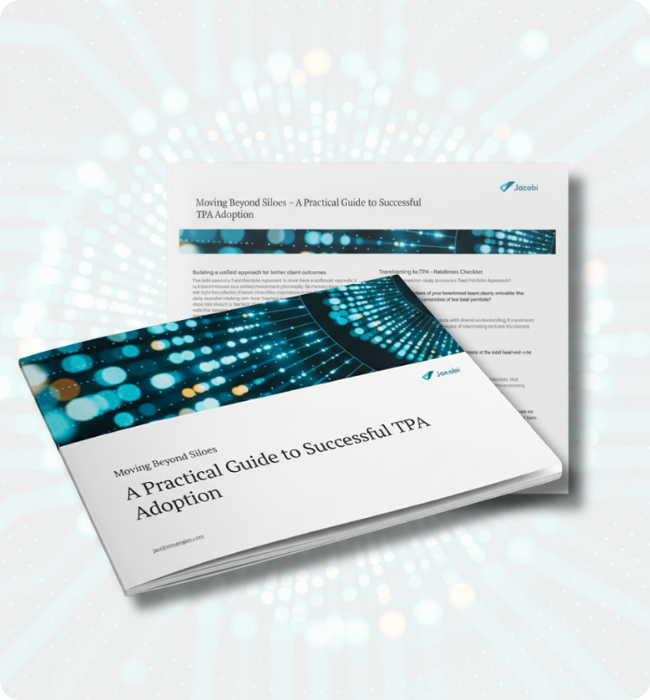
Still managing portfolios in siloes? It’s costing you more than you think
Most investment organizations are still operating in siloes. Asset class teams optimize in isolation. Data is fragmented across systems. Decisions are made without a clear view of total portfolio risk.
The result?
Misaligned investment decisions
Hidden risk exposures
Missed opportunities for true diversification
And despite growing awareness of the Total Portfolio Approach (TPA), many teams still struggle to implement it in practice.
Transitioning to a Total Portfolio Approach isn’t just a technical upgrade, it’s a fundamental shift in how investment teams think, operate, and make decisions.
But here’s the problem - most firms believe they need to solve their entire data challenge first - they don’t. This guide challenges that assumption and shows how leading organizations are building TPA capabilities alongside their existing processes, not after them.
What's in the TPA guide?
Most content on Total Portfolio Approach (TPA) is theoretical. This guide focuses on how TPA actually gets implemented inside investment organizations, including:
- Real-world constraints (data gaps, legacy systems, incentives)
- Practical modeling approaches
- Technology and operating model considerations
It’s designed for teams who need to move from concept to execution.
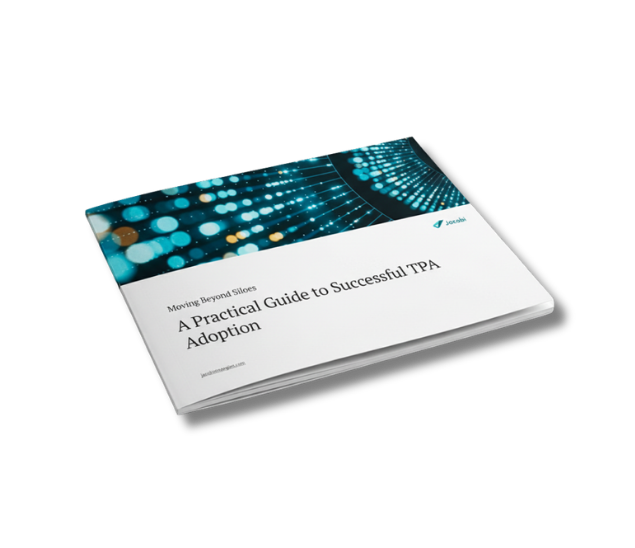
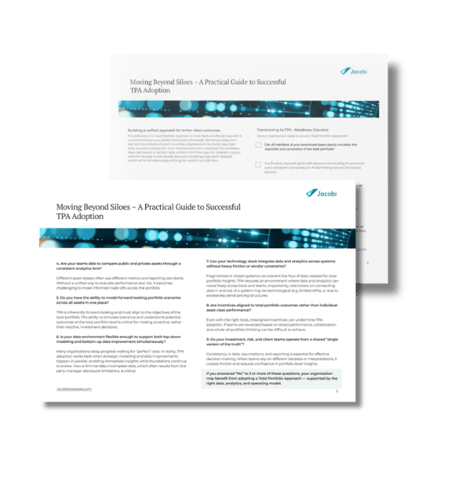
A TPA guide for investment teams like yours!
A guide to Total Portfolio Approach, for investment teams moving beyond siloed decision-making.
OCIOs & Outsourced Investment Teams
Asset Owners & Institutional Investors
Multi-asset Portfolio Managers
Investment Strategy and Risk Teams
If you’re responsible for portfolio construction, asset allocation, or investment governance, this guide is for you.
What you'll learn about TPA
Inside this practical guide, you’ll discover:
-
How to start TPA without a “big bang” data project
Move forward with strategy and modeling while your data foundation evolves.
-
The difference between Total Portfolio View vs Total Portfolio Approach
Why confusing the two slows down progress.
-
How to create a unified analytics framework across asset classes
So public and private assets can finally be assessed on a consistent basis.
-
The operating model required to support TPA
Including how to balance flexibility with governance and avoid “closed system” traps.
-
Why culture and incentives are the biggest barriers to change
And how to align teams around total portfolio outcomes.
-
A TPA Readiness Checklist
Quickly assess where your organization stands and what’s holding you back.

Some of the investment management teams already scaling with Jacobi
Customization & Scalability Without Complexity
Jacobi’s Total Portfolio Approach (TPA) solution is built for flexibility—offering a range of configuration options to meet the diverse needs of institutional investors. By enabling user-defined groupings, custom scenario modeling, and tailored risk factor-based simulations, it seamlessly integrates with existing governance processes and reporting workflows. The result is a holistic, multi-asset framework that can be adapted to changing market conditions—without adding layers of operational complexity.

.png)
.png)